Rain, Fireworks and Patriotic Pride Marked Scotland County’s Centennial Fourth
By Mike Scott
MEMPHIS, Mo. — In 1876, as the United States marked the 100th anniversary of American independence, Scotland County joined the rest of the nation in looking backward with pride and forward with uncertainty.
The Centennial year opened with a sense that the country stood at a historic crossroads. The Memphis Reveille noted in January that 1876 would be “one of the most eventful in the history of the country.” The Centennial Exposition in Philadelphia was expected to draw visitors from around the world to study America’s progress in arts, manufacturing, commerce and social life. At the same time, the country faced a presidential election year, and newspapers warned that questions of corruption, reform and national character would be tested before the year was over.
Locally, the Centennial spirit quickly became part of everyday newspaper chatter. Scotland County papers joked that residents might hear the word “Centennial” so often before the year ended that they would tire of it. The year was ushered in at Memphis with ringing bells and the “burning of powder,” while cities across the nation welcomed “seventy-six” with cannon fire.
By early summer, some Scotland County residents were already making their own connections to the national celebration. Thomas McAllister left for the Centennial Exhibition and was expected to be gone six weeks or two months. A lengthy “Centennial Letter” later printed in The Scotland County News described the wonders of the Philadelphia exposition, from machinery and art displays to exhibits from nations around the world. The writer defended the fair against those who dismissed it as a scheme to make money, saying no one could fully understand its size and importance without seeing it in person.
But the main local event was the Fourth of July celebration at Memphis.
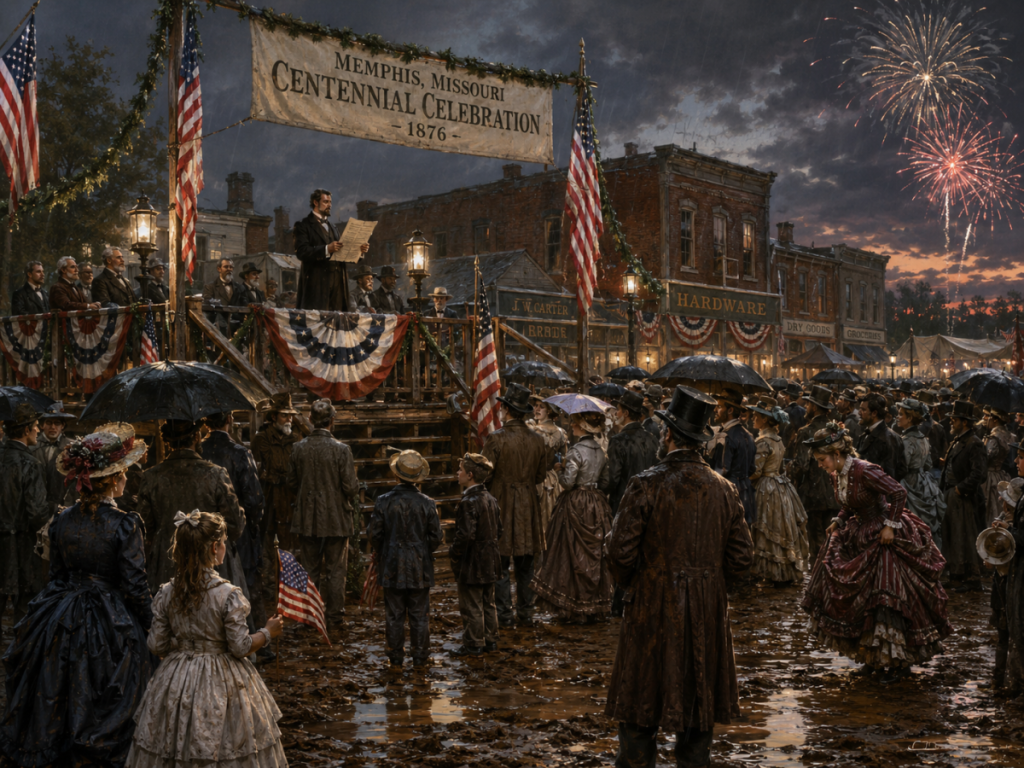
Great preparations were made by citizens to celebrate the nation’s 100th birthday at the fairgrounds. The day before, the weather looked promising. Then, as one newspaper put it, “the windows of heaven were opened.” Heavy rain fell, swelling creeks, turning roads to mud and making travel into town impossible for many. Some who came to Memphis could not return home because the water rose so quickly.
The storm forced organizers to adjust. Instead of holding the program at the fairgrounds as planned, the celebration was moved to the public square. By noon, despite the weather, a crowd of 600 to 800 visitors had gathered in town. Another account said sidewalks filled with people eager for the program, which began at 1 p.m.
The official exercises included music, a reading of the Declaration of Independence, an oration, a history of Scotland County, speeches, toasts and responses. Dr. E.H. Brumbaugh read the Declaration of Independence “in a clear, distinct manner,” and the Rev. J.S. Smith delivered the main oration, described as about an hour long and filled with historical facts.
George T. Collins read a lengthy historical sketch of Scotland County, which the paper hoped to print later if a copy could be obtained. The program also included patriotic toasts, with responses to “The President of the United States,” “The Patriots of ’76,” “America,” “The 100th Anniversary of American Independence,” “The Fourth of July,” “Scotland County,” and even “The Three Editors of Memphis.”
Not all of the toasts were solemn. One honored “The girls of Memphis,” with the line, “Lord bless ’em; how pretty they are.” Another saluted “The women of ’76,” praising their patriotism and devotion to the country.
The weather remained part of the story throughout the day. Near evening, rain fell again and sent some of the “fair sex” running for shelter. Still, the celebration continued. At dusk, fireworks lit the evening and were described as grand, brilliant and imposing. One report said the display excelled any previous fireworks effort in Memphis.
The day ended with a Centennial ball at Mason’s Opera Hall. Before the holiday, organizers had promised good music, good order and a good time, with tickets costing $1. Afterward, the paper reported the ball was not largely attended and was not a financial success, but those present said they enjoyed themselves.
Even with bad weather, muddy roads and flooded creeks, local newspapers judged the day a success. One report said good order prevailed throughout the celebration and, with favorable weather, it would have been the grandest observance Scotland County had ever seen. Another concluded that the event was “measurably successful,” especially considering the conditions.
The Memphis Conservative gave the celebration a humorous title — “The Gal-orious 4th” — and noted that while older residents remained at home or chose quieter ways to mark the day, young people came out “en masse,” braving mud, water and Cupid’s “wily snares.”
The writer closed with a wish that if residents lived to see another Centennial, they might “take passage in an ark similar to Noah’s.”
For Scotland County, the Centennial of 1876 was more than a patriotic anniversary. It was a day of rain-soaked roads, swollen creeks, speeches, music, fireworks, dancing, humor and determination. The weather tried to spoil the celebration, but Memphis still gathered, read the Declaration, told the county’s story and marked the nation’s first 100 years.